
Choosing the right batching plant is an important decision for contractors, infrastructure companies and concrete producers working on projects where mobility, production efficiency and setup flexibility matter. A mobile concrete batching plant can be useful for projects that require concrete production closer to the worksite or where the plant needs to be relocated between projects.
However, choosing equipment based only on production capacity or purchase price can lead to operational challenges later. Buyers should evaluate plant configuration, mixing technology, mobility, material handling, automation, after-sales support, spare parts availability and the supplier’s experience.
When comparing Mobile Concrete Batching Plant Manufacturers, it is important to understand your project requirements first. The right equipment should match your expected concrete output, available space, aggregate requirements, transportation arrangements and operating environment.
How Do You Choose a Mobile Concrete Batching Plant Manufacturer & Supplier?
To choose a reliable Mobile Concrete Batching Plant Supplier, compare the plant’s production capacity, mobility, mixer configuration, automation, build quality, installation requirements, spare-parts availability, service support and total operating cost.
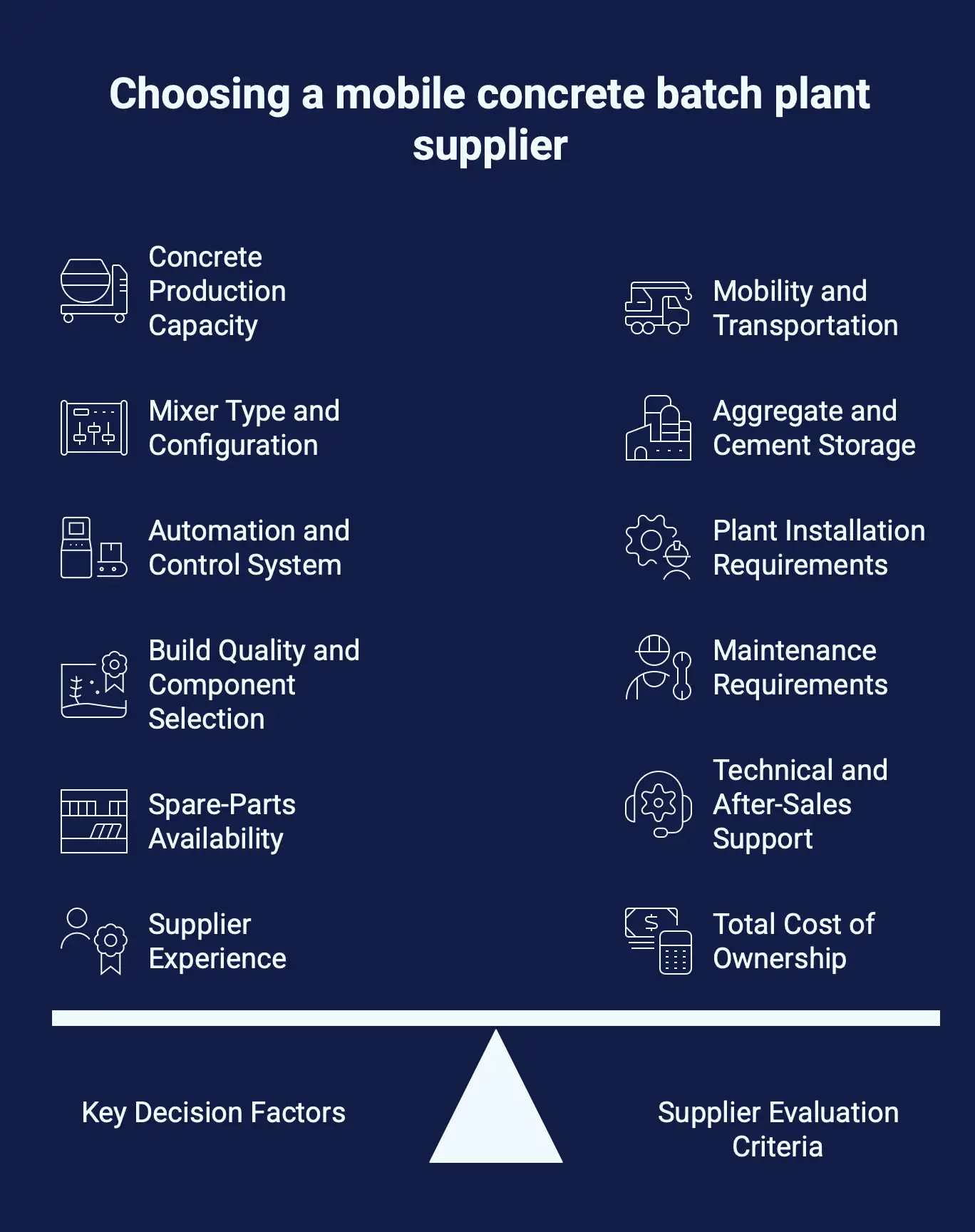
Key factors to evaluate:
- Required concrete production capacity
- Mobility and transportation requirements
- Mixer type and configuration
- Aggregate and cement storage capacity
- Automation and control system
- Plant installation requirements
- Build quality and component selection
- Maintenance requirements
- Spare-parts availability
- Technical and after-sales support
- Supplier experience
- Total cost of ownership
A suitable plant should be selected according to the project’s actual production and operating requirements rather than simply choosing the largest or cheapest available model.
1. Define Your Project Requirements
Before contacting suppliers, determine what your project actually needs.
Start by reviewing:
- Expected concrete production volume
- Project duration
- Number of work locations
- Available installation area
- Required concrete mix types
- Aggregate requirements
- Transportation limitations
- Power availability
- Environmental conditions
- Expected operating hours
For example, a large infrastructure project may require significantly different equipment from a smaller construction project. Having these details ready allows suppliers to recommend a configuration that is appropriate for your application.
2. Check the Plant’s Production Capacity
Production capacity is one of the most important specifications when comparing batching plants. Buyers should distinguish between theoretical capacity and the output that can realistically be achieved under actual operating conditions. Factors such as material loading, mixer cycle time, moisture, material availability and operator efficiency can affect production.
A reliable Mobile Concrete Mixing Plant Manufacturer should be able to clearly explain the plant’s rated capacity and the conditions associated with that specification. Instead of selecting equipment solely by maximum capacity, choose a configuration that aligns with your expected project demand.
3. Evaluate Mobility and Transportation
Mobility is one of the primary reasons companies choose mobile batching equipment. When evaluating a Mobile Concrete Plant Manufacturer, check how the plant is designed to be transported, installed and relocated.
Consider:
- Transportation dimensions
- Transportation weight
- Setup requirements
- Relocation process
- Foundation requirements
- Assembly time
- Number of components requiring separate transportation
A mobile plant should provide practical mobility without creating unnecessary logistical complexity.
4. Examine the Mixer Configuration
The mixer is central to concrete production, so its design and configuration deserve careful attention.
Ask suppliers about:
- Mixer type
- Mixing capacity
- Mixing cycle
- Wear components
- Maintenance access
- Replacement parts
- Cleaning requirements
The appropriate mixer depends on the concrete specifications and production requirements of the project. A supplier should be able to explain how the selected mixer configuration matches your intended application.
5. Review Aggregate and Material Handling
Consistent material handling is essential for reliable concrete production.
Review the plant’s approach to:
- Aggregate storage
- Aggregate feeding
- Cement handling
- Water measurement
- Additive dosing
- Material weighing
Accurate measurement and consistent feeding can contribute to repeatable concrete batching. When comparing Mobile Concrete Batching Plant Manufacturers, ask for clear information about the weighing systems and material-handling components used in the proposed configuration.
6. Check Automation and Control Systems
Modern batching plants may include automated control systems that help operators manage recipes, weighing, batching and production records.
When reviewing automation, consider:
- Control interface
- Recipe management
- Weighing controls
- Production monitoring
- Data recording
- Operator access
- Troubleshooting features
The system should be practical for your operators and suitable for the expected production environment. Ask the supplier whether operator training and technical support are included.
7. Consider a Mini Mobile Concrete Batching Plant
Not every project requires a large plant. Smaller contractors may benefit from equipment designed around lower production requirements and limited site space. A Mini Mobile Concrete Batching Plant Manufacturer can provide configurations intended for projects where compact equipment and mobility are important considerations.
Before choosing a mini plant, evaluate:
- Required output
- Project duration
- Available space
- Transportation requirements
- Concrete demand
- Storage capacity
- Future expansion requirements
A smaller plant can be appropriate when the project does not justify the capacity or footprint of a larger system.
8. Evaluate Build Quality and Components
The plant’s overall construction quality can influence maintenance requirements and operating reliability. Ask about the materials and components used in areas such as:
- Structural frame
- Mixer
- Conveyors
- Weighing systems
- Motors
- Control components
- Cement handling
- Aggregate bins
Buyers should also ask about wear parts and their expected replacement intervals. A lower initial purchase price may not provide the best long-term value if maintenance and replacement costs are significantly higher.
9. Check Spare Parts and After-Sales Support
After-sales service is one of the most important factors when selecting a supplier.
Before purchasing, ask:
- Are spare parts readily available?
- How quickly can replacement components be supplied?
- Is technical support available?
- Does the supplier provide installation assistance?
- Is operator training offered?
- What warranty is provided?
- How are service requests handled?
A Mobile Concrete Batch Plant Supplier that provides clear information about service and spare parts can make long-term equipment ownership easier to manage.
10. Compare Supplier Experience
Experience matters when purchasing specialized equipment. When comparing Mobile Concrete Batching Plant Suppliers, review their experience with projects similar to yours.
Consider whether they understand:
- Your required production capacity
- Project conditions
- Transportation requirements
- Installation considerations
- Concrete applications
- Maintenance requirements
Ask for relevant technical information and project references where available.
11. Evaluate the Total Cost of Ownership
The purchase price is only one part of the total cost. A proper comparison should consider:
- Initial equipment cost
- Transportation
- Installation
- Power consumption
- Maintenance
- Wear parts
- Spare parts
- Operator requirements
- Relocation costs
- Service expenses
This approach can provide a more realistic view of the equipment’s long-term value. A plant with a higher initial price may have different operating and maintenance costs than a lower-priced alternative.
12. Look for a Reliable Mobile Concrete Batching Equipment Manufacturer
The manufacturer should be able to provide clear technical specifications and support throughout the equipment’s operating life. When evaluating a Mobile Concrete Batching Equipment Manufacturer, look for:
- Transparent specifications
- Engineering support
- Quality components
- Documentation
- Installation assistance
- Operator training
- Spare-parts support
- After-sales service
Talk to Our Plant Experts
Ask technical questions before making a purchase. A supplier that communicates clearly during the buying process can be easier to work with after installation. Atlas Industries provides concrete batching and construction equipment solutions for projects requiring practical and production-focused plant configurations.
Questions to Ask Before Buying
Before finalizing a purchase, ask the supplier:
- What is the plant’s rated production capacity?
- What mixer configuration is included?
- How is the plant transported?
- How long does installation typically require?
- What foundation or site preparation is needed?
- What automation system is provided?
- What components are included?
- Which spare parts should be stocked?
- What warranty is provided?
- What technical support is available?
- Are operator training and documentation included?
- What are the expected maintenance requirements?
Getting clear answers can make it easier to compare different equipment configurations.
Final Thoughts
Choosing a mobile batching plant is a long-term equipment decision, so buyers should evaluate more than the initial purchase price. Production capacity, mobility, mixer configuration, material handling, automation, component quality and after-sales support can all affect the plant’s suitability for a project.
Start by defining your production requirements and site conditions. Then compare Mobile Concrete Batching Plant Manufacturers and suppliers based on technical specifications, total ownership costs and service capabilities.
A reliable supplier should provide clear information and help you understand how the proposed equipment fits your project requirements. Taking time to compare these factors can help you select a mobile concrete batching solution that supports efficient and dependable concrete production. Atlas Industries offers construction equipment solutions for businesses evaluating mobile concrete batching equipment based on project requirements, production needs and operating conditions.
Frequently Asked Questions
Q1. How do I choose reliable Mobile Concrete Batching Plant Manufacturers?
A1. Compare production capacity, plant configuration, mobility, automation, build quality, spare-parts availability, service support and supplier experience.
Q2. What should I look for in Mobile Concrete Batching Plant Suppliers?
A2. Look for clear specifications, reliable equipment, transparent pricing, technical support, spare-parts availability and after-sales service.
Q3. What does a Mobile Concrete Mixing Plant Manufacturer provide?
A3. Depending on the supplier, they may provide mobile batching plant systems, mixers, material-handling equipment, control systems and related technical support.
Q4. Who is a good Mobile Concrete Batch Plant Supplier?
A4. A supplier provides mobile batching plant equipment and may also offer installation, technical assistance, spare parts and service support in the long run. Such a supplier should be evaluated and choosen.
Q5. How do I compare a Mobile Concrete Plant Manufacturer?
A5. Compare equipment specifications, capacity, mobility, components, automation, maintenance requirements, warranty and after-sales support.
Q6. Is a Mini Mobile Concrete Batching Plant suitable for small projects?
A6. It can be suitable when project demand, available space and required production capacity align with the plant’s specifications.
Q7. What should I ask a Mobile Concrete Batching Equipment Manufacturer?
A7. Ask about capacity, mixer configuration, automation, transportation, installation, spare parts, warranty, maintenance and technical support.
