
Road construction and maintenance depend heavily on accurate bitumen application. Whether the material is being applied for tack coating, prime coating, surface dressing, or another approved roadwork application, consistent spray coverage can directly affect the quality and durability of the finished surface. Proper calibration of spraying equipment helps ensure that the required quantity of bitumen is distributed evenly across the specified area.
A bitumen sprayer machine that is not correctly calibrated may apply too much or too little material. Over-application can increase material consumption and create surface problems, while under-application can reduce bonding and affect pavement performance.
For contractors, understanding calibration is therefore an important part of efficient roadwork operations. Modern equipment such as a truck-mounted bitumen sprayer, bitumen spray tanker, or bitumen sprayer truck can provide controlled material distribution when the machine is correctly configured, maintained, and calibrated according to the manufacturer’s recommendations.
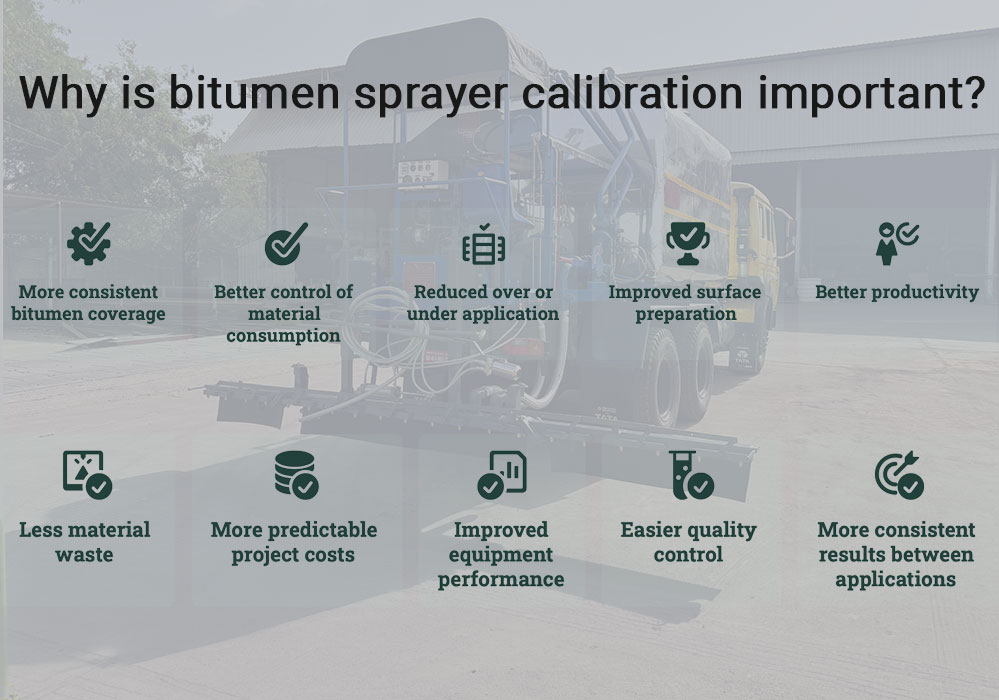
Why Is Bitumen Sprayer Calibration Important?
Proper calibration helps a bitumen sprayer apply the intended quantity of material consistently across the required road surface. It involves checking factors such as spray rate, nozzle condition, application width, pump performance, vehicle speed, and material characteristics.
Key benefits include:
- More consistent bitumen coverage
- Better control of material consumption
- Reduced over- or under-application
- Improved surface preparation
- Better productivity
- Less material waste
- More predictable project costs
- Improved equipment performance
- Easier quality control
- More consistent results between applications
Calibration should be performed using the equipment manufacturer’s procedures and the specifications applicable to the particular roadwork project.
What Does Bitumen Sprayer Calibration Mean?
Calibration is the process of verifying that a spraying system delivers the intended quantity of bituminous material over a defined area. A bitumen pressure distributor typically uses a pump, spray bar, nozzles, controls, and a tank system to distribute bitumen at a controlled rate. The actual application rate depends on several variables, including pump output, nozzle configuration, spray width, vehicle speed, material temperature, and pressure.
Why Accurate Application Rate Matters
Every road project has specific material requirements. Applying bitumen consistently helps contractors work toward the specified application rate and surface coverage. If the application rate is too high, potential issues can include excessive material consumption, surface flushing, tracking, or other problems depending on the application and materials involved. If the rate is too low, insufficient coverage may affect bonding or surface treatment performance. Accurate calibration allows operators to identify differences between the intended and actual output before large areas are treated.
Check the Bitumen Sprayer Machine Before Calibration
Before beginning calibration, inspect the complete machine. For a bitumen sprayer machine, important checks can include:
- Tank condition
- Pump operation
- Spray bar alignment
- Nozzle condition
- Filters and strainers
- Pressure gauges
- Valves
- Hoses
- Control system
- Temperature monitoring equipment
- Safety systems
Blocked or damaged nozzles can create uneven spray patterns. Worn components can also affect the consistency of material delivery. Cleaning and maintenance should always follow the equipment manufacturer’s instructions.
Verify Nozzle Condition and Spray Pattern
Nozzles play an important role in achieving consistent coverage. Different nozzle configurations can influence spray angle, overlap, and distribution.
Operators should inspect the nozzles for:
- Blockages
- Wear
- Damage
- Uneven spray patterns
- Incorrect positioning
- Inconsistent flow
The spray bar should also be correctly aligned and positioned according to the equipment design. A calibration check should confirm that the spray pattern is appropriate for the selected operating configuration rather than relying only on visual assumptions.
Check Pump Output and Pressure
The pump is responsible for moving bitumen from the tank to the spray system. Pump performance should be checked as part of the calibration process. A bitumen pressure distributor may use controlled pressure and pump operation to achieve the required material flow.
However, pressure alone is not an adequate measure of application rate because flow can also be affected by material viscosity, temperature, nozzle condition, and other equipment variables. Operators should compare actual system performance against the manufacturer’s specifications and project requirements.
Consider Vehicle Speed
Vehicle speed directly affects the amount of material applied per unit area. If the spray output remains constant while the vehicle travels faster, less material will generally be deposited over each unit of road surface. If the vehicle slows down without adjusting the spray system, the application rate may increase.
For a bitumen sprayer truck, maintaining a controlled and consistent travel speed is therefore an important part of achieving predictable application. Operators should use the equipment’s speed-control and application systems where available and follow the specified operating procedure.
Check Material Temperature
Bitumen and bituminous emulsions can have different handling and spraying characteristics depending on the material being used. Temperature can influence viscosity and therefore affect pumping and spraying performance.
A material that is too viscous may not flow through the system as intended, while inappropriate heating can create safety and material-quality concerns. Before operation, verify the required material temperature from the material supplier’s instructions and the equipment manufacturer’s recommendations.
Perform a Controlled Calibration Test
A controlled test provides useful information about actual spray output. The exact calibration method should follow the machine manufacturer’s instructions and the roadwork specification. Depending on the equipment, contractors may verify output by measuring material delivered over a known area or by using the machine’s calibrated monitoring system.
The test should account for:
- Spray width
- Vehicle speed
- Pump output
- Nozzle configuration
- Material characteristics
- Operating temperature
- Pressure or flow settings
Once the measured output is compared with the required application rate, adjustments can be made according to the approved operating procedure.
Use Calibration to Reduce Material Waste
Bitumen is a significant project input, so uncontrolled application can increase operating costs. For contractors comparing a bitumen sprayer machine price, it is important to consider more than the initial equipment cost. A machine with suitable controls, reliable components, accessible maintenance points, and accurate application monitoring may provide better operational value over its service life. Accurate calibration can help reduce unnecessary material consumption by keeping application closer to the required rate.
Maintain a Calibration and Inspection Record
Keeping records makes it easier to identify changes in equipment performance.
A calibration record can include:
| Item | Information to Record |
| Date | Calibration date |
| Equipment | Machine identification |
| Material | Bitumen or emulsion type |
| Spray width | Operating width |
| Nozzle setup | Configuration used |
| Vehicle speed | Test operating speed |
| Pressure/flow | Recorded setting |
| Measured output | Actual application result |
| Required rate | Project specification |
| Adjustment | Changes made |
| Operator | Person conducting test |
Regular documentation can also help maintenance teams identify recurring equipment issues.
Choose Equipment With Calibration in Mind
When purchasing or upgrading road spraying equipment, calibration capability should be considered from the beginning. A contractor evaluating a truck-mounted bitumen sprayer or bitumen sprayer truck for sale should review:
- Spray-rate control
- Pump capacity
- Spray-bar width
- Nozzle configuration
- Tank capacity
- Temperature-control system
- Pressure monitoring
- Automation features
- Operator controls
- Maintenance accessibility
- Spare-parts availability
- Technical support
Depending on the project, contractors may also compare a portable bitumen sprayer or bitumen hand sprayer for smaller or specialized applications. Atlas Industries offers road construction equipment solutions, and buyers can evaluate spraying equipment based on application requirements, operating conditions, maintenance support, and long-term productivity rather than focusing only on the initial purchase price.
Calibration Helps Improve Overall Road Work Efficiency
Proper calibration contributes to efficiency in several ways. Consistent application can reduce rework, improve material planning, and make daily production more predictable. It can also help operators identify equipment problems earlier.
If a machine suddenly delivers a different output despite unchanged operating settings, the issue may indicate a blocked nozzle, pump problem, incorrect pressure, material-temperature variation, or another maintenance requirement. This makes calibration both a quality-control activity and a useful equipment-performance check.
Common Calibration Mistakes to Avoid
Several mistakes can reduce calibration accuracy:
Ignoring Nozzle Wear
Worn nozzles may change the spray pattern and flow rate.
Calibrating Only Once
Equipment performance can change over time. Calibration should be repeated according to the manufacturer’s recommendations, project requirements, and operating conditions.
Focusing Only on Pressure
Pressure is only one part of the spraying system. The actual application depends on multiple variables.
Ignoring Vehicle Speed
Changes in travel speed can change the application rate.
Skipping Equipment Maintenance
A calibration exercise cannot compensate for damaged or poorly maintained components.
Failing to Record Results
Without records, it becomes difficult to compare performance and identify trends.
Final Thoughts
Proper calibration is an important part of efficient bitumen spraying. It helps contractors verify that equipment is delivering material consistently and according to the required application rate. Regular inspection of nozzles, pumps, spray bars, controls, temperature systems, and vehicle speed can support reliable performance. Whether you are operating a bitumen spray tanker, bitumen sprayer machine, bitumen pressure distributor, or another spraying system, calibration should be combined with preventive maintenance and accurate record-keeping.
Before purchasing equipment, compare the technical specifications, calibration capabilities, service support, and operating requirements rather than considering bitumen pressure distributor price or initial machine cost alone. Atlas Industries can be considered when evaluating road construction equipment solutions based on project requirements and long-term operational needs.
FAQS
Q1. How often should a bitumen sprayer be calibrated?
A1. Calibration frequency depends on the equipment, manufacturer recommendations, operating conditions, and project requirements. It should also be reconsidered after significant maintenance or changes to the spraying configuration.
Q2. What factors affect bitumen spray rate?
A2. Pump output, vehicle speed, nozzle configuration, spray width, material temperature, viscosity, and system pressure or flow can all affect the application rate.
Q3. What is a bitumen pressure distributor?
A3. A bitumen pressure distributor is road construction equipment designed to distribute bituminous material over a surface at a controlled rate using a tank, pump, spray system, and associated controls.
Q4. Does bitumen sprayer machine price indicate performance?
A4. Not necessarily. Price should be evaluated alongside capacity, controls, build quality, maintenance requirements, technical support, and suitability for the intended application.
Q5. What is the difference between a bitumen sprayer truck and a portable bitumen sprayer?
A5. A bitumen sprayer truck is generally designed for larger-scale road applications and carries its spraying system on a vehicle. A portable sprayer may be more suitable for smaller or specialized applications, depending on its design.
Q6. How can contractors improve bitumen application accuracy?
A6. They can maintain equipment properly, inspect nozzles, control vehicle speed, monitor material temperature, verify pump performance, and conduct calibration checks according to manufacturer and project requirements.
Q7. Can calibration reduce bitumen consumption?
A7. Proper calibration can help reduce over-application and unnecessary material use by bringing actual application closer to the required rate.
Q8. What should I consider when buying a bitumen sprayer truck?
A8. Consider tank capacity, spray width, pump system, nozzle configuration, temperature control, automation, calibration features, maintenance access, spare parts, and technical support.
